
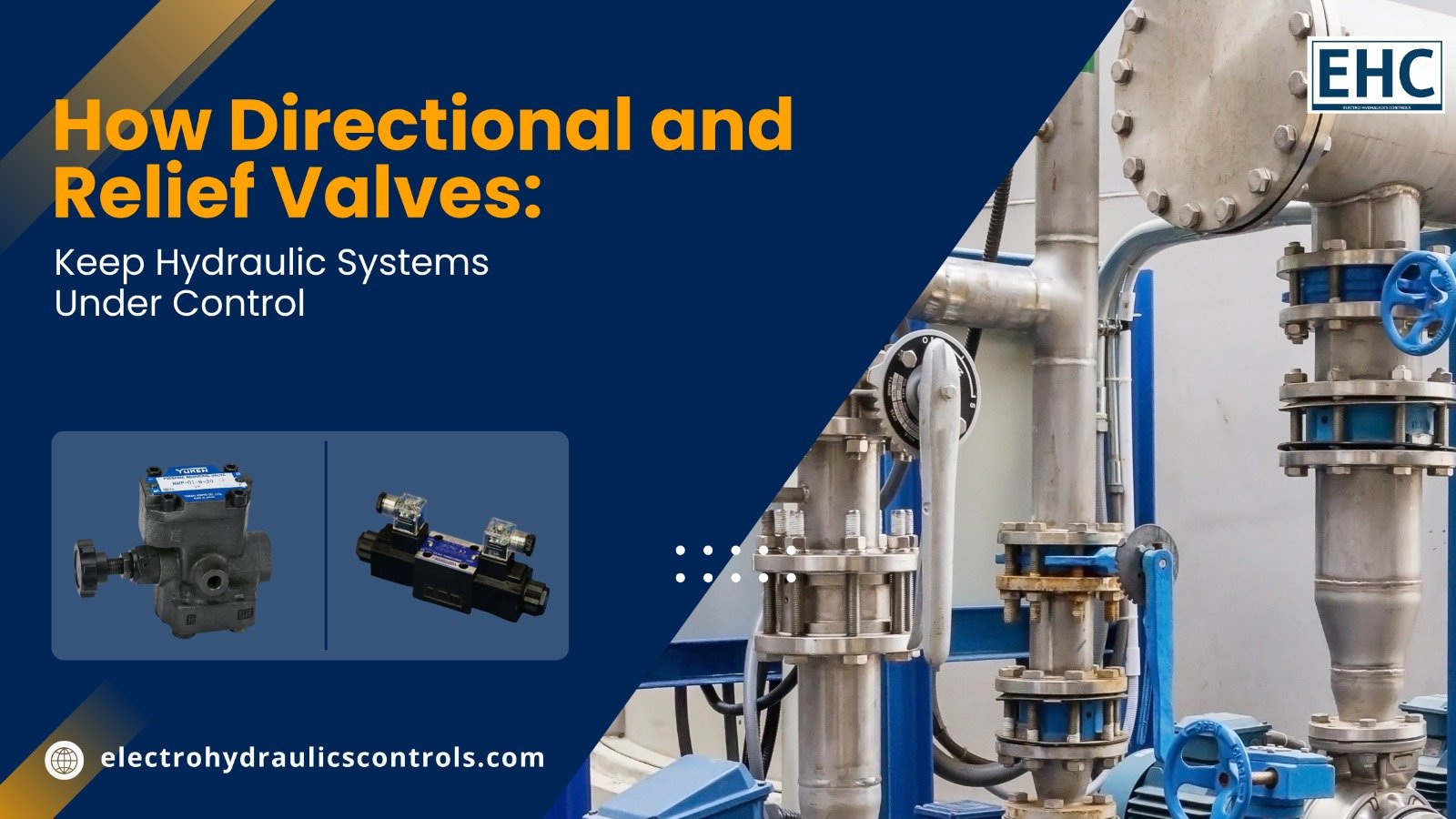
How Directional and Relief Valves Keep Hydraulic Systems Under Control
Hydraulic Systems Under Control
Introduction
A hydraulic machine may look like a collection of pumps, cylinders, motors, pipes, and fittings working together. But underneath that machinery is a carefully controlled flow of hydraulic fluid and the valves controlling that flow can determine whether the entire system operates smoothly or struggles with pressure, movement, and performance issues.
Two components that play very different but equally important roles are the Eaton directional control valve and the Yuken relief valve. One determines where hydraulic fluid should go, while the other helps prevent pressure from exceeding a safe or intended level.
Understanding the difference between these valves is important when designing, upgrading, or maintaining a hydraulic system. Choosing the wrong valve or selecting one without considering pressure, flow, configuration, and application requirements can affect efficiency, reliability, and component life.
So, how do these valves work, and how do you know which specifications matter?
Let’s break it down.
Why Hydraulic Valves Matter More Than You Think
Hydraulic systems are essentially about controlling energy.
A pump generates hydraulic flow, the fluid carries that energy through the circuit, and actuators such as cylinders or motors convert it into mechanical movement. Valves sit between these components and determine how that energy is controlled.
A valve can decide:
- Which direction hydraulic fluid flows
- When an actuator moves
- How much pressure a circuit can develop
- When pressure needs to be released
- Which parts of the system receive hydraulic flow
- How machinery starts, stops, extends, retracts, or holds a load
This is why valve selection should never be treated as a simple replacement exercise.
The valve needs to match the actual hydraulic circuit.
Understanding the Eaton Directional Control Valve
A directional control valve controls the path and direction of hydraulic fluid.
In simple terms, it tells the hydraulic oil where to go.
For example, in a hydraulic cylinder application, the valve may direct pressurized fluid toward one side of the cylinder to extend it. Changing the valve position can redirect fluid to the opposite side, allowing the cylinder to retract.
This seemingly straightforward function is essential for machinery that depends on controlled movement.
The Eaton directional control valve range available through Electro Hydraulics Controls includes electrically operated configurations designed for industrial hydraulic applications. One listed Eaton model, for example, is a four-way, three-position spool valve with a maximum flow of 120 LPM and maximum pressure of 350 bar.
What Does “Directional Control” Actually Mean?
Imagine a hydraulic cylinder that needs to perform three basic actions:
Extend → Stop/Hold → Retract
The hydraulic pump may continuously provide the required flow, but the cylinder cannot perform these movements correctly without controlling the direction of that flow.
That is where the directional valve comes in.
Its internal spool changes position to connect different ports within the hydraulic circuit. Depending on the valve configuration, hydraulic fluid can be directed toward the actuator, returned to the tank, or blocked in a particular position.
The exact operation depends on the valve’s spool configuration and circuit design.
Key Factors When Selecting a Directional Control Valve
Choosing a directional valve involves much more than selecting a familiar brand.
1. Maximum Operating Pressure
The valve must be capable of handling the pressure generated by the hydraulic system.
Using a valve below the required pressure rating can create reliability and safety concerns.
2. Flow Capacity
Flow determines how quickly hydraulic actuators can operate.
A valve that cannot accommodate the required flow can introduce excessive pressure drop and restrict system performance.
3. Number of Ports
Directional valves can have different port arrangements depending on the hydraulic circuit.
The number and configuration of ports need to correspond with the requirements of the system.
4. Spool Configuration
The spool determines how the ports are connected in different valve positions.
Different applications require different spool arrangements, particularly when cylinders need to extend, retract, stop, or hold their position.
5. Actuation Method
Directional valves can be operated in different ways, including manual, hydraulic, pneumatic, or electrical actuation.
For automated industrial equipment, electrically operated valves can be particularly useful because their operation can be integrated into a machine’s control system.
What Is a Yuken Relief Valve?
Now let’s move from direction to pressure.
A relief valve performs a very different job.
A hydraulic pump can generate substantial pressure, and if that pressure rises beyond the desired system limit, components may be subjected to excessive loads.
A relief valve provides a controlled way of limiting system pressure.
When pressure reaches the valve’s set point, the valve allows hydraulic fluid to pass through the relief path, helping prevent pressure from continuing to rise beyond the intended level.
Yuken relief valves are available in different configurations for hydraulic pressure-control applications. Electro Hydraulics Controls lists Yuken modular, remote-control, and solenoid-operated relief-valve options among its hydraulic valve offerings.
Why Pressure Protection Is Essential
Think of a hydraulic circuit as a system designed to operate within a specific pressure range.
Too little pressure, and the machinery may not generate enough force.
Too much pressure, and the system can experience unnecessary stress.
That can affect components such as:
- Pumps
- Cylinders
- Motors
- Hoses
- Seals
- Fittings
- Valves
A properly selected relief valve helps keep pressure within the intended operating range.
For example, one Yuken modular pressure relief valve listed by Electro Hydraulics Controls has a maximum pressure rating of 210 bar, a flow rating of 35 LPM, and a pressure adjustment range of 0–140 bar.
These specifications illustrate why engineers should look at the actual operating requirements rather than selecting a valve based only on its name.
Eaton Directional Control Valve vs Yuken Relief Valve
Although both components belong to the hydraulic valve family, their primary jobs are completely different.
| Feature | Eaton Directional Control Valve | Yuken Relief Valve |
| Primary function | Controls direction of hydraulic fluid | Controls/limits hydraulic pressure |
| Main purpose | Controls actuator movement | Protects the hydraulic circuit from excessive pressure |
| Controls | Flow path | Pressure |
| Typical application | Cylinders, hydraulic motors, automated machinery | Pump circuits, pressure-control systems, hydraulic protection |
| Important specification | Flow rate and pressure rating | Pressure setting, flow capacity, pressure rating |
| Common operation | Spool changes flow paths | Opens or regulates when pressure reaches the set condition |
| Selection considerations | Ports, spool configuration, actuation, pressure and flow | Pressure range, flow, mounting, circuit configuration |
| Role in system | Motion control | Pressure protection |
The important takeaway is simple:
A directional control valve tells the fluid where to go. A relief valve helps determine how much pressure the system is allowed to develop.
How the Two Can Work Together
The most interesting part is that these valves don’t necessarily compete with one another.
They can work together in the same hydraulic system.
Consider a machine using a hydraulic cylinder.
The pump supplies hydraulic fluid. The directional control valve determines whether the cylinder extends or retracts. Meanwhile, the relief valve provides pressure protection if system pressure rises to the specified limit.
The result is a circuit where both movement and pressure are controlled.
This division of responsibilities is fundamental to hydraulic system design.
Why Valve Selection Should Start With the Application
One of the easiest mistakes in hydraulic engineering is choosing a component first and trying to make the system fit around it.
The better approach is the opposite.
Start with the machine.
Ask:
What pressure does the system operate at?
What flow rate is required?
What type of actuator is being controlled?
How quickly does the actuator need to move?
Does the actuator need to stop and hold its position?
How will the valve be actuated?
What type of mounting or connection is required?
Once these requirements are clear, selecting the appropriate valve becomes much easier.
Common Applications
Hydraulic directional and relief valves are used across a wide range of industrial equipment.
Manufacturing Machinery
Hydraulic presses, forming machines, injection equipment, and production systems require controlled movement and pressure.
Directional valves can manage actuator movement while relief valves provide pressure protection.
Construction Equipment
Excavators, loaders, lifting equipment, and other heavy machinery depend on hydraulic power for movement.
Reliable flow and pressure control are particularly important when equipment operates under demanding loads.
Agricultural Machinery
Modern agricultural equipment uses hydraulic systems for steering, lifting, implements, and other functions.
Compact and reliable valve solutions can help maintain consistent machine operation.
Material Handling Equipment
Lifting and positioning systems often depend on hydraulic cylinders.
Precise directional control becomes important when equipment needs smooth and repeatable movement.
What Happens When the Wrong Valve Is Selected?
The consequences aren’t always immediately obvious.
A valve may physically fit into a system and still be the wrong choice.
For example, an undersized directional valve may restrict flow and create unnecessary pressure drop. A relief valve with an unsuitable pressure range may not provide the intended protection.
Other problems can include:
- Slow actuator movement
- Excessive heat generation
- Pressure instability
- Unwanted noise
- Poor machine response
- Premature component wear
- Increased maintenance requirements
This is why technical specifications should always be checked against actual operating conditions.
Maintenance Matters Too
Even a high-quality valve needs a suitable operating environment.
Hydraulic contamination is one of the major factors that can affect hydraulic component performance. Dirt, particles, degraded fluid, and moisture can contribute to wear and malfunction.
A sensible maintenance approach should include:
- Monitoring hydraulic fluid condition
- Maintaining appropriate filtration
- Checking for leaks
- Inspecting hoses and fittings
- Monitoring abnormal pressure changes
- Checking valve operation
- Following manufacturer recommendations
- Keeping the hydraulic circuit clean during maintenance
Good maintenance isn’t simply about fixing a valve after failure.
It is about reducing the likelihood of failure in the first place.
Why Specifications Should Never Be Ignored
A product name tells you what a component is.
Its specifications tell you whether it belongs in your system.
When selecting hydraulic valves, engineers and maintenance teams should pay attention to details such as:
- Maximum operating pressure
- Maximum flow
- Pressure adjustment range
- Port size
- Mounting type
- Valve configuration
- Actuation method
- Electrical specifications, where applicable
- Operating temperature
- Fluid compatibility
For example, the listed Eaton DG4V5 model uses a CETOP 05/NG10/ISO 05 interface and has a specified maximum flow of 120 LPM and maximum pressure of 350 bar.
Meanwhile, Yuken relief-valve models can differ substantially in their flow capacity, pressure rating, mounting style, and adjustment range.
That difference is precisely why selecting a valve based on brand alone isn’t enough.
Why Work With a Specialized Hydraulic Supplier?
Hydraulic systems can become complicated quickly.
A supplier that understands hydraulic components can help businesses move beyond simply purchasing a part and instead identify a component that fits the application.
Electro Hydraulics Controls offers hydraulic valves from brands including Eaton, Yuken, Rexroth, and Sun Hydraulics, along with hydraulic pumps, motors, filters, accessories, and repair services.
This broader product understanding can be useful when a valve needs to work as part of an entire hydraulic circuit rather than as an isolated component.
Frequently Asked Questions
1. What is an Eaton directional control valve?
An Eaton directional control valve is a hydraulic valve designed to control the direction of hydraulic fluid within a circuit. By changing the flow path, it can control the movement of hydraulic cylinders or motors.
2. What is a Yuken relief valve used for?
A Yuken relief valve is used for hydraulic pressure control and protection. It helps prevent system pressure from exceeding the intended limit by providing a controlled relief path.
3. Can a directional control valve and relief valve be used together?
Yes. They perform different functions and can work together in the same hydraulic circuit. The directional valve manages fluid direction, while the relief valve provides pressure protection.
4. How do I select a directional control valve?
Consider the required flow rate, operating pressure, number of ports, spool configuration, mounting interface, actuation method, and the type of actuator being controlled.
5. How do I select a relief valve?
Start by identifying the required pressure range, maximum system pressure, flow requirements, mounting configuration, and the specific function the valve needs to perform in the circuit.
6. Why is flow capacity important?
If a valve cannot handle the required flow, it can create excessive pressure drop and restrict actuator performance. Matching valve flow capacity to the hydraulic circuit is therefore important.
7. Why is hydraulic cleanliness important?
Contaminated hydraulic fluid can contribute to wear and malfunction in valves, pumps, motors, and other components. Proper filtration and fluid maintenance can help improve system reliability.
Conclusion
Hydraulic systems may look complicated from the outside, but their performance often comes down to how effectively a relatively small number of components manage flow, pressure, and movement.
The Eaton directional control valve plays a central role in deciding where hydraulic fluid travels and how actuators move. The Yuken relief valve, on the other hand, focuses on pressure management and protection. Used correctly, these components can become important parts of a hydraulic system designed for controlled, reliable operation.
The key is not simply choosing a well-known brand. It is choosing a valve that matches the actual requirements of the machine—including pressure, flow, configuration, mounting, and operating conditions.
When those details are considered carefully, hydraulic components can work together more efficiently, helping machinery operate with greater consistency and reducing avoidable performance and maintenance problems.
Author Bio
Electro Hydraulics Controls Team
Electro Hydraulics Controls provides hydraulic pumps, motors, valves, filters, accessories, and related hydraulic solutions for industrial and maintenance applications. The team focuses on helping customers identify suitable hydraulic components while also offering repair and support services for existing systems.

Add comment