
Available on backorder

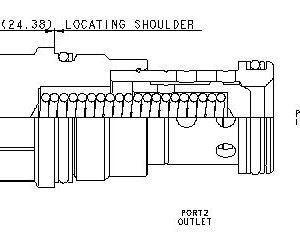
SUN HYDRAULICS Free flow nose to side check valve(CXHAXEN)
£453.60
Free-flow, nose-to-side check valves are on/off circuit components that allow free flow from the inlet (port 1) to the outlet (port 2) and block flow in the opposite direction.
- Two-port check valves share the same cavity for a given frame size, however, pay close attention as flow paths may be in opposite directions.
- Check valves offer extremely low leakage rates with a maximum leakage of less than 1 drop per minute (0,07 cc/min).
- Will accept 5000 psi (350 bar) at ports 1 and 2.
- Cartridges configured with EPDM seals are for use in systems with phosphate ester fluids. Exposure to petroleum based fluids, greases and lubricants will damage the seals.
Available on backorder

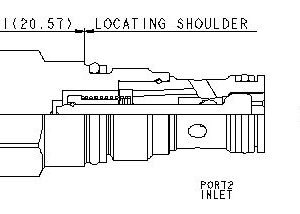
SUN HYDRAULICS Free flow side to nose check valve (CXADXAN)
£158.40
Free-flow, side-to-nose check valves are on/off circuit components that allow free flow from the inlet (port 2) to the outlet (port 1) and block flow in the opposite direction.
- Two-port check valves share the same cavity for a given frame size, however, pay close attention as flow paths may be in opposite directions.
- These check valves are considered circuit savers for existing circuits where manifold drillings are incorrect. The capacity of side-to-nose (port 2 to port 1) 2-port check valves is approximately 30% less than preferred models with a nose-to-side (port 1 to port 2) flow path.
- Check valves offer extremely low leakage rates with a maximum leakage of less than 1 drop per minute (0,07 cc/min).
- Will accept 5000 psi (350 bar) at ports 1 and 2.
Available on backorder

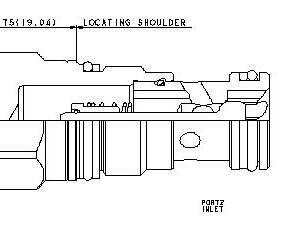
SUN HYDRAULICS Free flow side to nose check valve (CXCDXCV)
£180.00
Free-flow, side-to-nose check valves are on/off circuit components that allow free flow from the inlet (port 2) to the outlet (port 1) and block flow in the opposite direction.
- Two-port check valves share the same cavity for a given frame size, however, pay close attention as flow paths may be in opposite directions.
- These check valves are considered circuit savers for existing circuits where manifold drillings are incorrect. The capacity of side-to-nose (port 2 to port 1) 2-port check valves is approximately 30% less than preferred models with a nose-to-side (port 1 to port 2) flow path.
- Check valves offer extremely low leakage rates with a maximum leakage of less than 1 drop per minute (0,07 cc/min).
- Will accept 5000 psi (350 bar) at ports 1 and 2.
Available on backorder

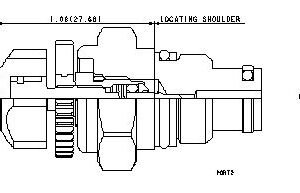
SUN HYDRAULICS Fully adjustable needle valve – pilot capacity(NFABKXN)
£205.20
Two-port, pilot-stage needle valves are fully adjustable devices used to regulate pilot flow in a main-stage valve or to meter in/out flow in low flow applications. These cartridges are designed for pilot flow applications and utilize Sun's T-8A cavity so they can be used in conjunction with Sun's pilot-operated, main-stage valves.
- Utilizes the Sun T-8A 2-port cavity making it the ideal choice to use in conjunction with Sun's main stage pilot or vent-to-operate cartridges. Separate pilot lines are eliminated and only one cavity needs to be machined to accommodate both the control and primary function. Note: All 2-position, 2-way pilot stage control cartridges utilize the same cavity and are physically interchangeable. Functionality is the only consideration.
- Note: The main stage valve should first be installed to the correct torque value followed by the T-8A pilot control section into the main stage valve to its required torque value.
- Ports 1 and 2 may be pressured to 5000 psi (350 bar).
- Needle adjusts from fully closed to fully open in three complete turns resulting in extremely fine resolution.
Available on backorder

SUN HYDRAULICS Fully adjustable needle valve – pilot capacity(RBAALCN)
£532.80
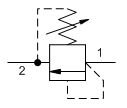
Direct-acting, pilot relief cartridges are used to remotely control the pressure setting of other pilot-operated valves. Because capacity is limited to pilot flow, these valves should be used with other higher flow valves.
- Main stage orifice is protected by a 150-micron stainless steel screen.
- Suitable for use in load holding applications.
- Back pressure on the tank port (port 2) is directly additive to the valve setting at a 1:1 ratio.
- Cartridges configured with EPDM seals are for use in systems with phosphate ester fluids. Exposure to petroleum based fluids, greases and lubricants will damage the seals.
- W and Y controls (where applicable) can be specified with or without a special setting. When no special setting is specified, the valve is adjustable throughout its full range using the W or Y control. When a special setting is specified, this setting represents the maximum setting of the valve.
Available on backorder


SUN HYDRAULICS Fully adjustable needle valve (NFBC-KCN)
Needle valves are fully adjustable orifices used to regulate flow. They are infinitely adjustable from fully closed up to the maximum orifice diameter. They are not pressure compensated and may be used as flow controls or as shutoff valves.
- All 2-port flow control cartridges are physically and functionally interchangeable (i.e. same flow path, same cavity for a given frame size). However, cartridge extension dimensions from the mounting surface may vary.
- Because needle valves are non-compensating devices, the fixed orifice size will regulate flow through the valve in proportion to the square root of the pressure differential across ports 1 and 2.
- A balanced adjustment mechanism allows for easy adjustment even at high pressures.
- The sharp-edged orifice design minimizes flow variations due to viscosity changes.
- The flow path through this valve is bi-directional. The preferred path is port 1 to 2, to allow interchangeability with other flow controls.
- There is no leakage when the adjustment mechanism is turned to the shut-off position.
- Cartridges configured with EPDM seals are for use in systems with phosphate ester fluids. Exposure to petroleum based fluids, greases and lubricants will damage the seals.
- Incorporates the Sun floating style construction to minimize the possibility of internal parts binding due to excessive installation torque and/or cavity/cartridge machining variations.
Available on backorder
SUN HYDRAULICS Fully adjustable needle valve (NFDCLAN)
£266.40
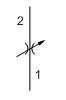
Needle valves are fully adjustable orifices used to regulate flow. They are infinitely adjustable from fully closed up to the maximum orifice diameter. They are not pressure compensated and may be used as flow controls or as shutoff valves.
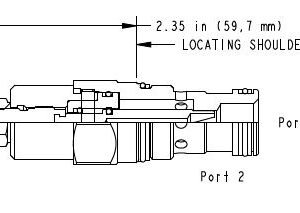
- All 2-port flow control cartridges are physically and functionally interchangeable (i.e. same flow path, same cavity for a given frame size). However, cartridge extension dimensions from the mounting surface may vary.
- Because needle valves are non-compensating devices, the fixed orifice size will regulate flow through the valve in proportion to the square root of the pressure differential across ports 1 and 2.
- A balanced adjustment mechanism allows for easy adjustment even at high pressures.
- The sharp-edged orifice design minimizes flow variations due to viscosity changes.
Available on backorder
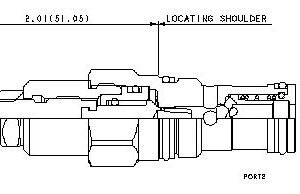
SUN HYDRAULICS Fully adjustable needle valve with reverse flow check (NCCBLAN)
£244.80
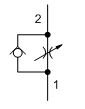
Needle valves with reverse-flow check are fully adjustable orifices used to regulate flow. They are infinitely adjustable from fully closed up to the maximum orifice diameter. An integral high-capacity check valve provides unrestricted flow from port 2 to port 1. They are not pressure compensated.
- All 2-port flow control cartridges are physically and functionally interchangeable (i.e. same flow path, same cavity for a given frame size). However, cartridge extension dimensions from the mounting surface may vary.
- Because needle valves are non-compensating devices, the fixed orifice size will regulate flow through the valve in proportion to the square root of the pressure differential across ports 1 and 2.
- The sharp-edged orifice design minimizes flow variations due to viscosity changes.
Available on backorder
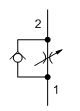

SUN HYDRAULICS Fully adjustable needle valve with reverse flow check (NCFCLCN)
£658.80
Needle valves with reverse-flow check are fully adjustable orifices used to regulate flow. They are infinitely adjustable from fully closed up to the maximum orifice diameter. An integral high-capacity check valve provides unrestricted flow from port 2 to port 1. They are not pressure compensated.
- All 2-port flow control cartridges are physically and functionally interchangeable (i.e. same flow path, same cavity for a given frame size). However, cartridge extension dimensions from the mounting surface may vary.
- Because needle valves are non-compensating devices, the fixed orifice size will regulate flow through the valve in proportion to the square root of the pressure differential across ports 1 and 2.
- A balanced adjustment mechanism allows for easy adjustment even at high pressures.
- The sharp-edged orifice design minimizes flow variations due to viscosity changes.
Available on backorder
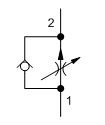

SUN HYDRAULICS Fully adjustable pressure compensated flow control valve with reverse flow check (FDCBHAN)
£777.60
Fully adjustable, pressure-compensated flow controls with reverse-flow check provide precise flow regulation for meter-in or meter-out applications where there may be wide pressure fluctuations. They are infinitely adjustable from nearly closed up to the maximum flow. An integral high-capacity check valve provides unrestricted flow from port 2 to port 1.
- All 2-port flow control cartridges are physically and functionally interchangeable (i.e. same flow path, same cavity for a given frame size). However, cartridge extension dimensions from the mounting surface may vary.
- A balanced adjustment mechanism allows for easy adjustment even at high pressures.
- The sharp-edged orifice design minimizes flow variations due to viscosity changes.
- Minimum leakage is .2 gpm (0,8 L/min) when the adjustment mechanism is turned to the shut-off position.
Available on backorder

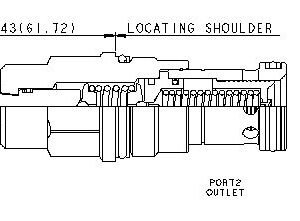
SUN HYDRAULICS Kick-down, pilot-operated, balanced piston relief valve (RQIBLAN)
£1,166.40
Kick-down relief cartridges act similar to a circuit breaker in an electrical system. The valves will kick completely open and remain open once the pressure at the inlet (port 1) exceeds the valve settting, creating an unrestricted flow path from port 1 to tank (port 2). The valve remains open as long as the pressure at port 1 exceeds the pressure at port 2. To reset the valve, flow from port 1 to port 2 must cease and pressure at port 2 must be equal to or greater than the pressure at port 1.
- All 2-port relief cartridges (except pilot reliefs) are physically and functionally interchangeable (same flow path, same cavity for a given frame size).
- To reset valve, flow through the cartridge must cease.
- Main stage orifice is protected by a 150-micron stainless steel screen.
- Not suitable for use in load holding applications.
Available on backorder
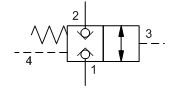
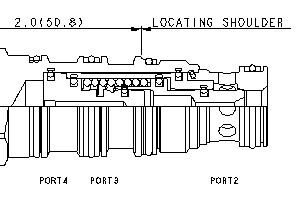
SUN HYDRAULICS Normally closed, balanced poppet, logic element – pilot-to-open(DKFSXHN)
£907.20
This is a normally closed, balanced poppet, switching element. Pilot pressure at port 3 shifts the valve to the open position.
- Unique balanced construction provides predictable switching with 5000 psi (350 bar) at both ports 1 and 2, with the external drain open and a minimum pilot pressure of 300 psi (20 bar).
- Port 1 and port 2 are fully sealed from port 3 and port 4. Ports 3 and 4 are positively sealed.
- Any backpressure at the drain port is directly additive to the required pilot pressure for reliable operation.
- Leakage rate between port 1 and port 2 is very low, typically less than 10 drops/min. at 5000 psi (0,7 cc/min at 350 bar).